Next-Generation Karyotyping: WGA-Free Single-Cell CNV Profiling
The complexity of cancer cannot be fully captured in bulk. Hidden subclones, transient genomic events, and treatment-resistant populations often remain undetected in averaged datasets. To uncover these dynamics, cancer research demands resolution at the level where changes originate: the single cell. Yet, despite decades of progress, karyotyping workflows have remained constrained: low-throughput, biased by amplification, and blind to heterogeneity. Semi-Permeable Capsule (SPC) technology changes this. It is a scalable, high-throughput platform designed to bring single-cell CNV profiling into everyday cancer research. With tools like Flux, even labs without microfluidics expertise can isolate and process tens of thousands of cells per run, maintaining compartmentalization of each individual cell throughout. This makes unbiased genome-wide karyotyping not only feasible but routine, bringing us closer to the real architecture of cancer. In an era of precision oncology, understanding tumor heterogeneity at scale isn’t just powerful – it’s necessary.
CNVs are central to today’s cancer diagnostics, prognostics, and therapeutic strategies
Copy number variation (CNV) is an important source of genetic variability in humans, influencing both normal and deleterious phenotypic traits. In cancer, the prevalence of CNVs has prompted comprehensive studies of CNV landscapes across tumor types. In the field of cell and gene therapy, genomic stability of engineered cell lines is a key indicator of clinical safety.
Conventional karyotyping methods, such as G-banding or molecular techniques based on hybridization arrays, often fall short due to low throughput or reliance on bulk genomic DNA, which obscures cellular heterogeneity. Recent advances in next-generation sequencing and single-cell sample preparation have significantly improved data resolution and depth. Single-cell DNA sequencing protocols that employ whole-genome amplification (WGA) are now available, however, their reliability and cost are not yet optimal.
The need is clear: accurate, pre-amplification-free single-cell CNV profiling at scale.
Single-cell CNV profiling workflow using Semi-Permeable Capsules
We developed a genome-wide CNV profiling technique based on the use of Semi-Permeable Capsules (SPCs) for cell isolation. SPCs are compartments with sieve-like walls, that keep the cells and nucleic acids partitioned inside, while allowing the free flow of the surrounding solution. SPC technology enables the isolation of 100s to 10,000s of cells or nuclei within semi-permeable compartments. Subsequent sample processing is equivalent to bulk workflows, allowing the scaling of complex workflows that are incompatible with conventional microfluidic approaches. Thus, SPCs enable easy multi-step processing of cellular genetic material and support a convenient and scalable combinatorial barcoding. Importantly, we demonstrate the feasibility of single-cell whole-genome library preparation without DNA pre-amplification, thereby alleviating data analysis challenges related to amplification bias.
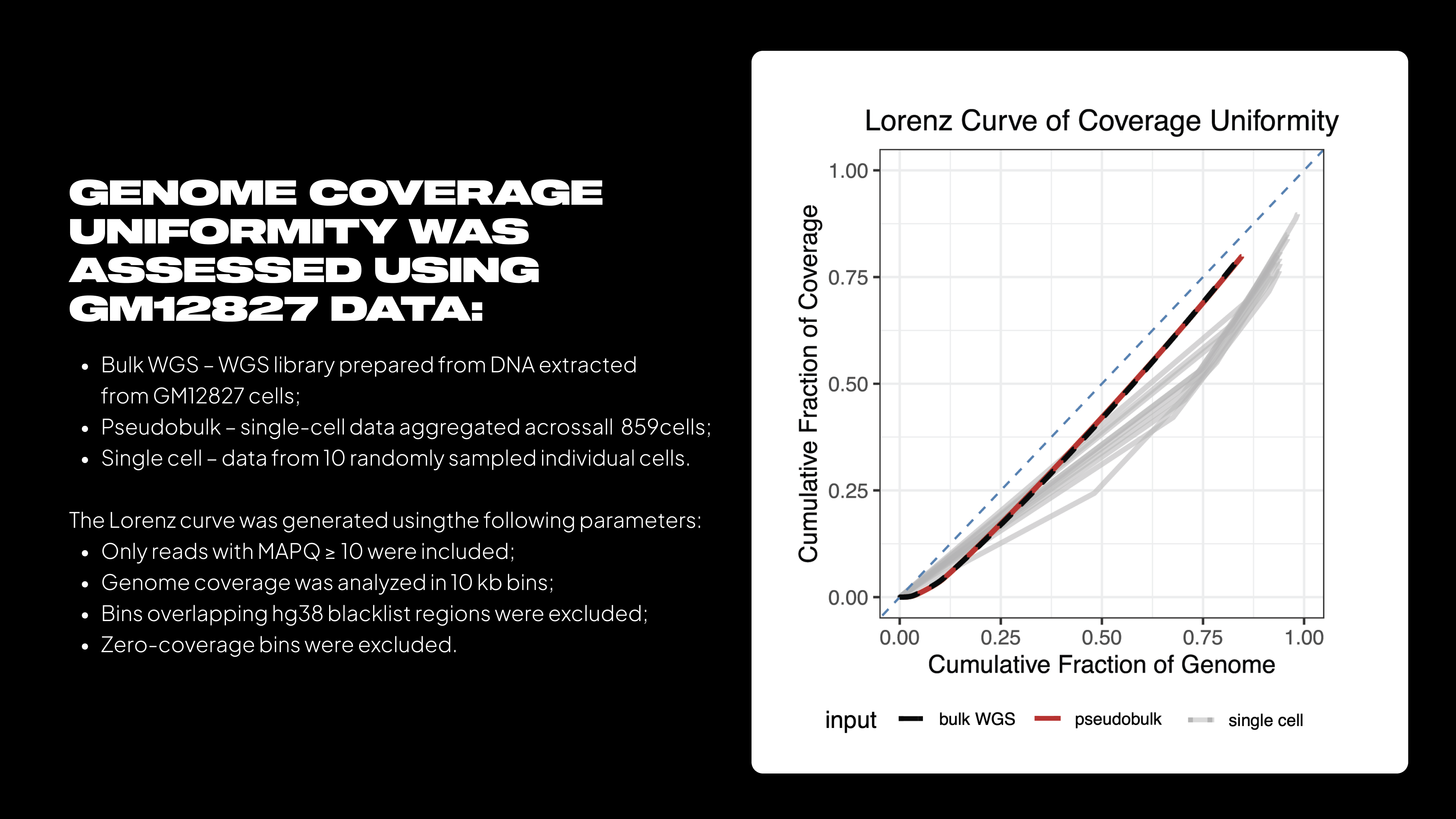
Lorenz curves for GM12827 single-cell, bulk, and pseudobulk datasets.
We conducted six barcoding experiments, processing approximately 60,000 cells from the GM12827 and K562 cell lines, and deeply sequenced a subset of 1,800 cells. We analyzed CNV profiles of individual cells and compared the results with the pseudo-bulk dataset. The best concordance in karyotype calls across per-cell coverage depths was observed at a 5 Mb resolution. The resulting karyotypes aligned well with expected cellular states. Notably, high-throughput single-cell analysis revealed rare subpopulations with CNV profiles that deviated from the pseudo-bulk consensus. For biological validation, we applied this protocol to nearly 2,000 cells from acute myeloid leukemia (AML) patient samples and identified rare populations with clinically significant aberrations that would likely be missed using bulk approaches.
Results: robust CNV profiles, clear karyotypes, and critically – rare aberrant subpopulations uncovered only through single-cell resolution.
This isn’t just a new workflow. This study expands the molecular profiling toolkit, offering a robust and scalable method for exploratory genotyping that supports both disease characterization and quality control of engineered cell lines.
Why Cancer Genomics Needs SPCs?
- No need for biased whole-genome amplification.
- Better representation of clonal diversity.
- Scalable, high-throughput workflows for up to 100,000 cells.
With CNVs playing key roles in tumor progression, resistance, and relapse, this level of insight is no longer optional.
Have a question for us? Email us at info@atrandi.com
16th Annual Meeting of the Cancer Genomics Consortium (CGC) | August 3-6, 2025, Houston, Texas
If you’re curious to hear the science straight from the source, join our talk "Next-Generation Karyotyping: WGA-Free Single-Cell CNV Profiling" on Sunday, August 3 from 4:15 to 4:30 PM. A short session, but packed with big ideas.
Join us at CGC 2025 Poster Session to see how SPC-based single-cell karyotyping redefines genomic analysis in cancer.
- Monday, August 4, from 5:45 to 6:45 PM | CGC Exhibit Hall.
- Tuesday, August 5, from 2:45 to 3:45 PM | CGC Exhibit Hall.
Whether you're working in clinical diagnostics, cancer genomics, or emerging cell therapy platforms, this is a chance to see how SPCs are reshaping single-cell analysis and karyotyping. Let’s talk about what your bulk data might be missing.
Visit us at Atrandi Booth #13 – let’s talk single-cell vs bulk analysis!