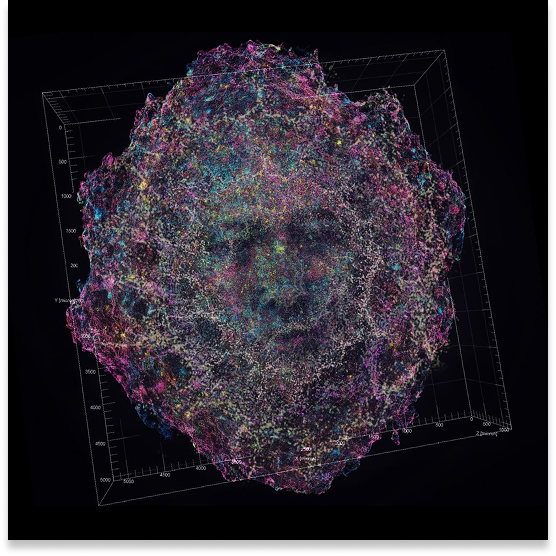
Prophecy of Cancer: from Ancient Egypt to Tumor Heterogeneity at Single-Cell Resolution
Cancer isn’t abstract, it’s common and personal. Bulk assays helped chart drivers and biomarkers, but they average tumors into a single number. Single-cell methods changed that, resolving clonal structure, rare subpopulations, and microenvironmental states that shape response and resistance. Droplet microfluidics then scaled scRNA-seq to tens of thousands of cells, turning the tumor ecosystem into a measurable object and enabling discoveries from immune programs in NSCLC to entirely new cell types. Yet droplets are closed reactors – great for speed but limited for multi-step biochemistry due to accumulation of reagents. Semi-Permeable Capsules (SPCs) solve that. Each capsule is a liquid core within a thin hydrogel shell that retains cells and long nucleic acids while small molecules diffuse. For eukaryotic research, that unlocks practical paths to joint DNA and RNA readouts for CRISPR assays, cancer genomics and fundamental cell-state mapping.
From Bulk to Single-Cell: Making Heterogeneity Visible
Bulk sequencing has been the backbone of oncology for decades: it charted drivers, biomarkers, and mutational processes across thousands of tumors. But bulk is an average. Variant allele fractions are skewed by purity, ploidy, and copy-number; rare clones are diluted and co-occurrence of events in the same cell is inferred rather than observed. Even with multi- region sampling and deconvolution, key questions about clonal structure and resistance mechanics remain underdetermined. And that’s a limitation of the container we use to explore this, not the ambition (Alizadeh et al., 2015; Ren et al., 2018).
Single-cell genomics removed that blur. On the DNA side, early studies used single-nucleus sequencing to expose discrete clonal expansions and evolutionary paths that bulk could not resolve – famously, a breast tumor whose liver metastasis traced to a founding clone in the primary (Navin et al., 2011). On the RNA side, single- cell RNA sequencing (scRNA-seq) mapped malignant and microenvironmental cell states, revealing programs linked to proliferation, hypoxia, immune evasion, and drug resistance within the same tumor (Patel et al., 2014). Together, these methods turned “intratumor heterogeneity” from a mystery into a measurable design variable. The field has since scaled from single studies to tumor atlases: coordinated efforts that integrate single-cell, multiparametric, spatial context, and longitudinal sampling to follow transitions from precancer to advanced disease and treatment response. These atlases aim to connect cell identities and neighborhoods to outcomes – precisely the level at which diagnostics, trial design, and drug discovery become actionable (Rozenblatt-Rosen et al., 2020).
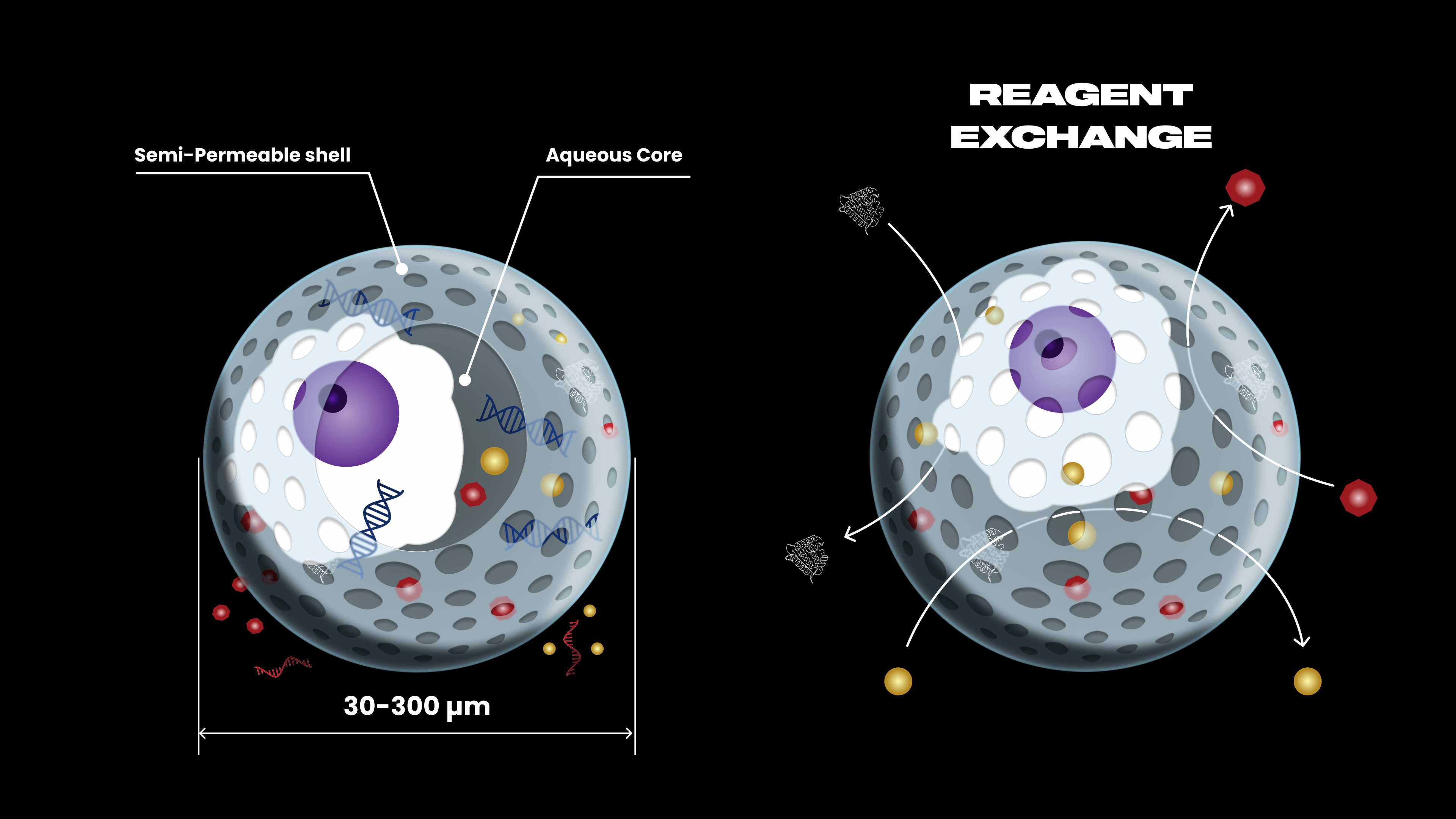
Semi-Permeable Capsule (SPC) structure and permeability.
Droplets scaled discovery – closed chemistry restricted it
Scalable scRNA-seq arrived with droplet microfluidics. But droplets are closed reactors: great for fast encapsulation, robust and biocompatible, but less suited to multi-step workflows. You can merge, split, or picoinject, yet reagent exchange limitations hinder workflow diversity and length, requiring complex techiques (Breukers et al., 2025).
Even with that limitation, droplets changed the scientific field. Drop-seq and the 10x Genomics platform (GEM) made transcriptomes of tens of thousands of cells routine, turning the “tumor microenvironment” into something we could measure rather than imagine (Macosko et al., 2015; Zheng et al., 2017). That scale revealed biology we didn’t knew to look for, like the CFTR- rich pulmonary ionocyte discovered by independent single-cell atlases of the airway (Plasschaert et al., 2018). And it sharpened our view of human tumors, where single-cell maps of tumor-infiltrating myeloid cells in NSCLC resolved dozens of reproducible states across patients (Zilionis et al., 2019).
As the questions moved from “who’s there?” to “which genotype drives which state in the same cell?”, the container became the bottleneck. Linking genotype (e.g., CNVs, SNVs, CRISPR edits) with state (transcriptional programs) in the same cell is the essence of multiomics and droplet limitations are constraining discovery. True multiomics needs full reagent exchange and this sets the stage for semi-permeable, open- workflow compartments.
...
Continue to the full piece here [SelectScience]